
General information, not medical advice. A doctor or physical therapist can assess your parent's balance and tell you which aid is safest for them.
When a parent starts holding on to furniture as they walk, families usually face the same question: cane or walker? Both are common, inexpensive and easy to find, but they do different jobs. Choosing the wrong one can mean either too little support or more equipment than your parent needs. Too much equipment often ends up folded in a closet.
In this guide we compare canes and walkers side by side: how much support each gives, who each one suits, how they affect daily life, and how to tell which one fits your parent. We also look at a middle option: a self-standing cane with a wider base and a second handle for standing up.
What is the difference between a cane and a walker?
A cane is held in one hand, usually on the side opposite the weaker leg. It widens your base of support, takes some weight off a painful or weak leg, and gives the brain extra information about where the ground is. That last point matters more than people think: a cane tip touching the floor helps many older adults feel steadier even when they aren't leaning on it much.
A walker is a frame you hold with both hands. Standard walkers are lifted and placed forward with each step. Two-wheeled walkers glide at the front. Rollators have four wheels, hand brakes and usually a seat. Because both arms share the load, a walker can carry much more weight and gives more stability in every direction.
The American Academy of Orthopaedic Surgeons describes canes as helpful when you need a little support for balance or a minor weakness, and walkers as the choice when you need more help with balance and weight bearing, for example after surgery.
How do canes and walkers compare side by side?
| Cane | Walker | |
|---|---|---|
| Support level | Light to moderate | Moderate to high |
| Hands used | One (the other stays free) | Both |
| Fits in small spaces | Yes: bathrooms, kitchens, narrow halls | Can be hard to turn in tight rooms |
| Stairs | Usable with a handrail | Not used on stairs |
| Travel and car | Light; folding models fit in a bag | Bulkier, even when folded |
| Best for | Mild imbalance, one-sided weakness or pain, confidence | Significant imbalance, weakness in both legs, recent surgery, repeated falls |
| How it feels to the user | Discreet, "still independent" | More noticeable; some people resist it |
Neither aid is "better". The right one is the one that gives your parent enough support for the way they actually move, and that they will actually use.
When is a cane the right choice?
A cane usually makes sense when your parent:
- Feels a little unsteady, especially on uneven ground, curbs or grass.
- Has pain or mild weakness in one hip, knee or ankle.
- Reaches for walls and furniture as they move around the house.
- Can walk safely without help, but wants more confidence.
- Gets up at night to use the bathroom and feels wobbly when half-awake.
- Struggles a bit to get up from a chair, bed or toilet.
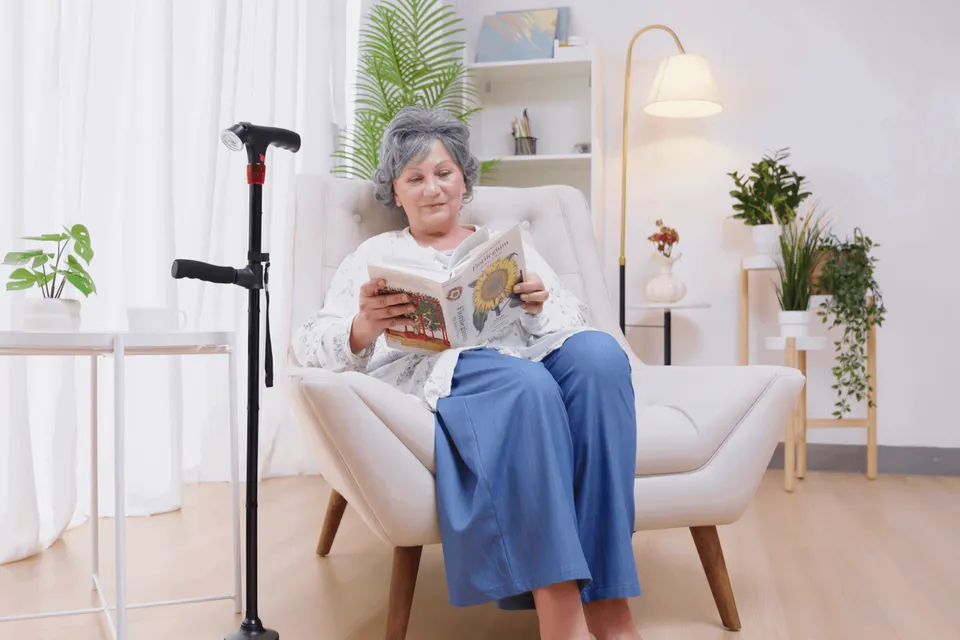
For these situations, a cane keeps one hand free for the handrail, a door, a cup of coffee or a grocery bag. That freedom is a big reason many older adults prefer a cane: it supports them without making them feel "handicapped," and it goes everywhere easily.
When does someone need a walker instead?
A walker is usually the safer choice when your parent:
- Has fallen more than once, or has a fall with no clear cause.
- Leans heavily on a cane, or the cane wobbles under their weight.
- Has weakness in both legs, not just one.
- Shuffles, takes very short steps or freezes when starting to walk.
- Is recovering from hip or knee surgery and has weight limits on one leg.
- Gets out of breath quickly and needs to stop and rest often (a rollator with a seat helps here).
If several of these apply, talk with your parent's doctor and ask for a physical therapy evaluation. A therapist can watch your parent walk, test balance and recommend the right type and size of aid. The CDC notes that more than one in four older adults falls each year and that falling once doubles the chance of falling again, so a professional opinion after a fall is always worthwhile.
Is there something in between a cane and a walker?
Yes, and for many families it's the sweet spot. A quad-base or self-standing cane has a wider base with several contact points instead of a single rubber tip. It gives more stability than a standard cane, stands on its own when you let go, and still fits through doorways and into a car like a regular cane.
The Ready Walker is a good example of this middle ground. According to the brand, it has:
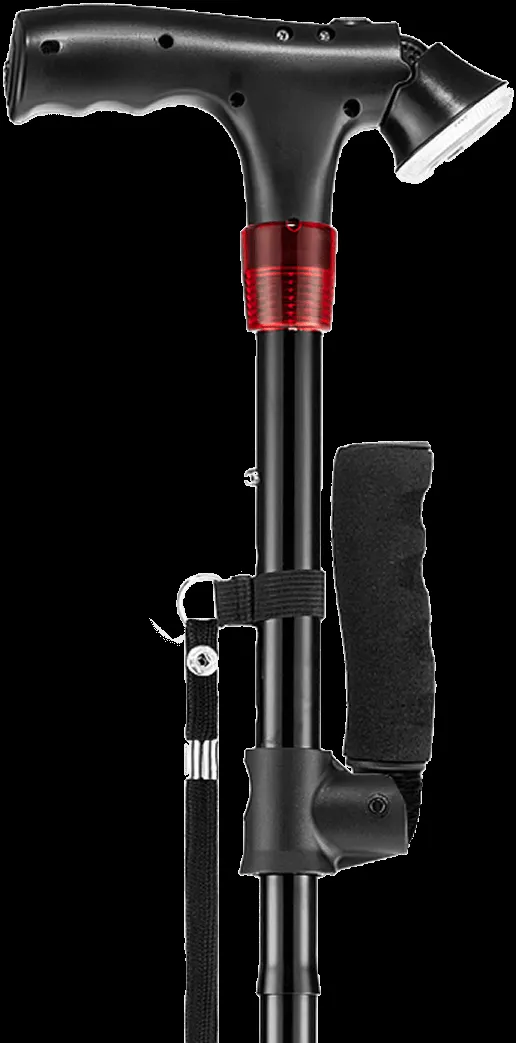
- A pivoting four-point base that stays in contact with the ground and lets the cane stand on its own.
- A second, lower handle that gives a push-off point when standing up from a chair, bed or toilet.
- A built-in LED light for nighttime trips to the bathroom.
- A built-in alarm to attract attention from people nearby.
- An aluminum frame that is height adjustable, folds for travel and supports up to 300 lbs.
For a parent who is "not ready for a walker" but clearly needs more than a basic cane, this combination covers the moments when falls often happen: standing up, walking in the dark and letting go of the cane to do something with both hands. Read our full Ready Walker review for the details.
Not ready for a walker? Try a smarter cane
The Ready Walker stands on its own, has a second handle for standing up, an LED light for nighttime and a built-in alarm. $59.99 with a 30-day money-back guarantee.
Check today's price →$59.99 · ships from Ohio · 30-day guarantee
How does each aid change daily life at home?
Think about your parent's real day, not just walking down a hallway:
- Bathroom: most bathrooms are small. A cane fits beside the toilet and sink; a walker often has to be left at the door. A cane with a second handle also helps with standing up from the toilet.
- Kitchen: carrying a plate or cup is hard with a walker unless it has a tray or basket. With a cane, one hand stays free.
- Stairs: walkers aren't used on stairs, so homes with steps often need a cane on each floor or a cane plus handrails.
- Getting out: a folding cane fits in a purse, a car door pocket or a restaurant corner. A walker usually needs the trunk.
- Nighttime: many falls happen on the way to the bathroom in the dark. A cane with a built-in light helps your parent see the floor without switching on every lamp.
Walkers win when stability is the top priority and space isn't an issue, for example in a single-floor home with wide doorways, or for longer walks outside with a rollator seat for breaks.
How should a cane or walker be sized?
Both aids are sized the same way. With your parent standing straight in their usual shoes, arms relaxed at their sides, the handle should line up with the crease of the wrist. When they hold the handle, the elbow should bend slightly, about 15 to 20 degrees. AAOS OrthoInfo gives the same rule.
A cane that's too tall pushes the shoulder up and gives less support. One that's too short makes your parent stoop. Recheck the height whenever they change shoes. Our guide on how to use a cane correctly covers which hand to use, walking patterns and stairs.
What if your parent refuses a walker or a cane?
This is very common. Many older adults link a cane or walker with "getting old" and would rather hold on to furniture. A few approaches help:
- Frame it as independence: "This lets you keep doing your walks and your shopping on your own."
- Start small: a stylish folding cane feels less dramatic than a walker, and many parents accept it more easily.
- Point to the features: a light for nighttime and a handle for standing up are practical tools, not "medical equipment."
- Involve the doctor: advice from a doctor or therapist often carries more weight than advice from a son or daughter.
- Let them choose: the color, the style, where it lives in the house.
How much do canes and walkers cost?
Basic canes start around $15 to $30, and feature-rich canes like the Ready Walker cost about $60. Standard walkers start around $40 to $70, and rollators range from about $70 to well over $200. Medicare Part B may cover some walkers and canes as durable medical equipment when a doctor prescribes them, so ask the doctor and check with Medicare if cost is a concern.
The Ready Walker was $59.99 on the official checkout in October 2026, with shipping from Ohio and a 30-day money-back guarantee, so your parent can try it at home and decide.
Can someone use both a cane and a walker?
Yes. Many older adults use a walker for longer outings and a cane around the house, or a walker after surgery and then a cane as they recover. Others keep a cane upstairs and a walker downstairs. The goal is the right support for each situation, and that can change over time. Recheck every few months, or after any illness, hospital stay or fall.
What else lowers the risk of falling at home?
Any walking aid works best in a safer home:
- Remove loose rugs and clutter from walkways.
- Add night lights between the bedroom and bathroom.
- Install grab bars by the toilet and in the shower.
- Put sturdy handrails on both sides of the stairs.
- Encourage strength and balance exercise, with the doctor's OK.
- Have vision and medications reviewed every year.
Our room-by-room fall prevention guide walks through each part of the house. The National Institute on Aging also lists home changes that help older adults stay safely in their homes.
How do you decide, step by step?
- Watch your parent walk around the house for a day. Note where they grab furniture, slow down or seem unsure.
- Ask about falls and near-falls. Many older adults don't mention them.
- Talk to the doctor, especially after any fall, and ask whether a physical therapy evaluation makes sense.
- Match the aid to the need: light support and confidence → cane; heavy leaning or both legs weak → walker.
- Fit it properly and practice together at home.
- Recheck after any change in health.
Related guides: quad vs single-point canes and walking safety.
The bottom line
A cane is the right aid for light support, balance and confidence, and it keeps one hand free and fits everywhere. A walker is the right aid when your parent needs to lean heavily, has weakness in both legs or has fallen repeatedly. For the many parents in between, a self-standing cane with a wider base, a second handle for standing up and a light for nighttime is often the most practical choice.
Our pick for that middle ground is the Ready Walker. Check today's Ready Walker price, or read more in our guides on the best cane for seniors and how to use a cane.
Sources
- American Academy of Orthopaedic Surgeons (OrthoInfo). How to Use Crutches, Canes, and Walkers.
- Centers for Disease Control and Prevention. Older Adult Falls: Facts and Stats.
- National Institute on Aging. Aging in Place: Growing Older at Home.
Frequently asked questions
Is a cane or a walker better for balance?
A walker gives more stability because both hands share the load, so it suits people with significant balance problems. A cane is enough for mild imbalance and confidence, and keeps one hand free.
How do I know if my parent needs a walker?
Warning signs include repeated falls, leaning heavily on a cane, weakness in both legs, shuffling or very short steps, and recent hip or knee surgery. Ask their doctor or a physical therapist for an evaluation.
Is a quad cane as stable as a walker?
No. A quad or self-standing cane is more stable than a single-tip cane, but a walker still gives more support. It's a good middle option for people who need a bit more than a basic cane.
Can you use a cane on stairs?
Yes, with a handrail. Going up, step up with the stronger leg first; going down, lead with the cane and the weaker leg. Walkers are not used on stairs.
Does Medicare pay for canes and walkers?
Medicare Part B may cover canes and walkers as durable medical equipment when a doctor says they are medically necessary. Check with Medicare and the supplier before buying.
What is the Ready Walker cane?
A folding, height-adjustable cane with a pivoting four-point base that stands on its own, a second handle for standing up, an LED light and an alarm. It costs $59.99 with a 30-day money-back guarantee.

Laura Bennett
Laura Bennett is the pen name of the Aging Parents at Home editorial team at Iqueda Media LLC. We write for adult children who want to help their aging parents stay safe and independent at home. The team researches daily-living and safety products, reads the official guidance from public health and safety organizations, and checks prices, policies and buyer feedback. We are not doctors, nurses or physical therapists. Her guides are built on official public health and safety guidance, manufacturer information, checkout and return policies, and buyer feedback, and are updated when offers change. More about Laura.