
"Jar opener for seniors" is searched almost 3,000 times a month in the US, often by adult children who noticed a parent struggling with lids, or by older adults tired of waiting for help. It sounds like a small problem, but for people with arthritis or weaker hands, tight lids can make cooking frustrating and painful.
In this guide we compare every type of jar opener, explain what matters for weak or painful hands, and share how to tell when a parent could use one.
Why do jars get harder to open with age?
- Grip strength declines as muscle mass decreases with age.
- Arthritis makes twisting painful, especially at the base of the thumb and in the wrist.
- Vacuum-sealed lids require a strong initial "break" to open.
- Sticky residue on the threads glues lids shut.
The Arthritis Foundation notes that hand arthritis can make turning and opening items like jars difficult and painful, and that assistive devices can help.
What types of jar openers are there?
| Type | How it works | Pros | Cons |
|---|---|---|---|
| Rubber grip pad | Adds friction | Cheap, small | Still twisting with fingers and wrist |
| Multi-size grip cone or wrench | Slots for different lid sizes | Inexpensive | Still needs grip strength; limited sizes |
| Under-cabinet gripper | Lid wedged in a V; turn the jar with both hands | Uses both hands and arms | Needs installing; fixed in one spot |
| Electric opener | Motor grips and turns the lid | Almost no strength needed | Bulky, batteries, noise, size limits |
| Adjustable lever opener (Cap Crack) | Clamps the lid; long handle gives leverage | Fits many sizes, portable, no batteries | Takes a few seconds to adjust |
What matters most for weak or painful hands?
- Leverage: a longer handle multiplies force, so less strength is needed.
- Large-muscle use: turning with the arm instead of twisting with the fingers.
- A secure grip on the lid so it doesn't slip.
- Adjustability for small bottles to large jars.
- Simplicity: no small buttons, batteries or complicated steps.
- Light weight and easy storage.
The Arthritis Foundation describes how an opening aid that lets you use two hands and your large muscles distributes the force across multiple joints. Lever openers and under-cabinet grippers both follow that idea; a lever opener has the advantage of being portable and adjustable.
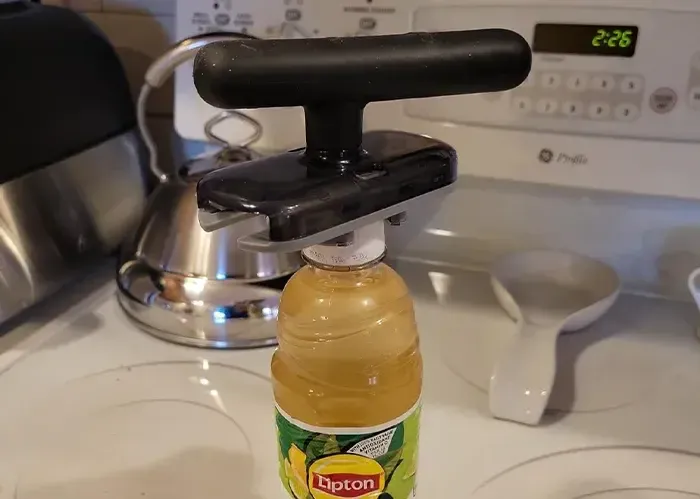
Are electric jar openers better?
They can be helpful for very weak hands, since the motor does almost all the work. But many people find them bulky, noisy and battery-hungry, and some only fit certain lid sizes or struggle with very tight seals. One Cap Crack buyer, 74, said he tried electric openers and found them "too noisy and heavy," while a manual lever opener felt "simple and reliable." If your parent has very limited hand function, ask an occupational therapist which option suits them best.
Which jar opener do we recommend for seniors?
Cap Crack is an adjustable manual opener designed especially for people with hand and wrist pain. According to Cap Crack:
- Adjustable to open any size jar or bottle.
- Ergonomic, curved handle that fits the palm and gives solid leverage.
- No batteries or electronics.
- Durable plastic, lightweight (under 1 lb), won't rust.
- Simple to use for adults of any age.
Buyers with arthritis and wrist surgery describe being able to open their own water bottles and jam jars again. It costs $29.99, or $19.99 each in the 5-pack, with a 90-day money-back guarantee. Read our full Cap Crack review.
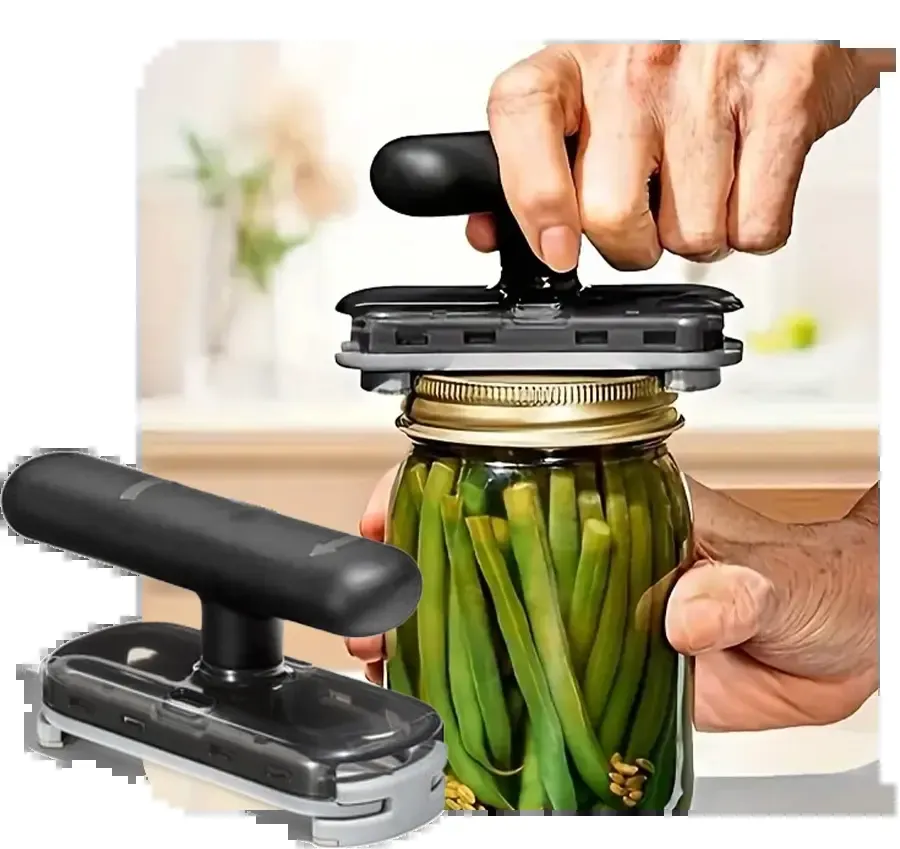
Our pick: the Cap Crack Jar and Bottle Opener
Adjustable, no-battery jar and bottle opener with an ergonomic handle that gives leverage, made for hands with arthritis or weak grip.
Check today's price →$29.99, or from $19.99 each in bundles
How can you tell a parent needs a jar opener?
- They ask for help with lids or wait for visitors to open things.
- They've stopped buying jarred foods they used to enjoy.
- You find lids loosely balanced on jars or containers left open.
- They use knives, teeth or hammers on lids.
- They mention hand, thumb or wrist pain.
Any of these is a sign that a small tool could restore a lot of independence in the kitchen.
What other kitchen aids help weak hands?
- Easy-grip utensils with thick, padded handles.
- Lever-style faucet and door handles.
- Lightweight cookware with two handles.
- Electric can openers.
- Non-slip mats to hold bowls and jars steady.
- Reachers for items on high shelves (or move items lower).
The Arthritis Foundation's list of self-help arthritis devices includes many of these, and an occupational therapist can recommend the right ones.
Which quick tricks help with any opener?
- Break the vacuum seal first by gently prying the lid edge with a spoon.
- Run warm water over a metal lid for 30 seconds.
- Steady the jar on a damp towel or non-slip mat.
- Keep your wrist straight and turn with your arm.
- Wipe the threads clean before closing, and don't over-tighten.
More tips in our guide how to open a tight jar.
Is a jar opener a good gift?
It's one of the most practical, affordable gifts for an aging parent, because they'll use it every day. It's also a gentle way to help without making a parent feel judged. Many families pair it with other small daily-living aids. See our gift guide for elderly parents.
How do small tools support independence?
The National Institute on Aging notes that most people want to stay in their own homes and stay independent as long as possible. Being able to cook and open your own food is part of that. Alongside a safer home (see our fall prevention guide) and the right mobility support (see our Ready Walker review), small tools like a jar opener help parents keep doing things for themselves.
Can an occupational therapist help?
Yes. The Arthritis Foundation notes that occupational therapists can suggest assistive devices and show people how to do daily activities with less pain. If your parent is struggling with several tasks, from buttons to cooking, an OT evaluation can identify the most helpful tools and techniques. Ask their doctor for a referral.
How do you choose the right jar opener for your parent?
- Watch how they open jars now. Do they struggle to grip, or to turn?
- Consider their hands. For pain at the base of the thumb or wrist, avoid tools that still require twisting.
- Think about where they'll use it. A portable opener works anywhere; an under-cabinet one stays in the kitchen.
- Keep it simple. The best tool is the one they'll actually use.
- Check the guarantee so you can try it with their real jars.
What about bottles?
Water, juice and soda bottles can be just as hard as jars, and staying hydrated matters for older adults. An adjustable opener that also handles bottle caps, like Cap Crack, covers both. Buyers mention being able to open their own water bottles again, which is a small but real boost to independence.
How do you care for a jar opener?
- Wash it with warm, soapy water after sticky jars.
- Dry it before storing.
- Keep it in a handy drawer near where jars are stored.
- Check moving parts occasionally to make sure they adjust smoothly.
Should you buy more than one?
Many families do: one for the kitchen, one by the fridge or pantry, and one for a relative or neighbor who also struggles. With bundle pricing, extra openers cost less each, and they make thoughtful small gifts.
Which jar opener myths can you ignore?
- "Only people with severe arthritis need one." Anyone with weaker grip or occasional hand pain benefits.
- "Electric is always easier." Not always; bulk, noise and size limits can make them frustrating.
- "A towel works just as well." It adds grip, but you still twist with your fingers and wrist.
- "Using a tool means giving up independence." The opposite: the right tool lets your parent keep doing things themselves.
How do you suggest one without hurting feelings?
Present it as a kitchen gadget that "everyone loves," not as a medical aid. Show how easy it makes even your own jars. Many families find that once a parent tries it on a stubborn jar, it quickly becomes a favorite tool.
Is a good jar opener expensive?
No. Most manual openers cost between $10 and $30, and even a well-designed adjustable opener like Cap Crack is $29.99, or $19.99 each in bundles. Compared with the frustration of waiting for help, or the risk of using knives on lids, it's one of the best-value tools you can buy for an aging parent.
It's a small purchase that removes a daily frustration, and for many older adults, it's the difference between asking for help and doing it themselves.
If your parent cooks often, it's worth trying a good opener with their own pantry jars during the guarantee window. Most families find it's one of those small purchases they wish they'd made years earlier, once they see how much easier daily cooking becomes.
The bottom line
For seniors with weak or painful hands, the best jar opener uses leverage and larger muscles instead of finger strength. Rubber pads help a little, under-cabinet grippers work but stay in one place, and electric openers can be bulky. An adjustable lever opener is often the best balance of ease, versatility and simplicity.
Our pick is Cap Crack: adjustable, no batteries and easy on arthritic hands, from $19.99 each in bundles. Check today's Cap Crack price.
Sources
- Arthritis Foundation. Expert Q&A: Tips for Opening Devices.
- Arthritis Foundation. Self-Help Arthritis Devices.
- National Institute on Aging. Aging in Place: Growing Older at Home.
- Official Cap Crack product page and checkout, checked October 2026.
Frequently asked questions
What is the best jar opener for seniors?
One that uses leverage and larger muscles instead of finger strength, adjusts to many lid sizes and is easy to use with one hand. Our pick is Cap Crack.
Are electric jar openers good for arthritis?
They need almost no strength, but some are bulky, noisy, battery-hungry and only fit certain lid sizes. A good manual lever opener is simpler for many people.
Do rubber jar grips work?
They help a little by improving grip, but you still twist with your fingers and wrist, which is what hurts with arthritis.
What is an under-cabinet jar opener?
A V-shaped gripper mounted under a cabinet. You push the lid in and turn the jar with both hands. The Arthritis Foundation notes it spreads the force across multiple joints.
Can a jar opener open bottles too?
Many adjustable openers, including Cap Crack, work on water bottles, soda bottles and medicine-style caps as well as jars.
How do I know if my parent needs a jar opener?
If they ask for help with lids, avoid certain foods, use their teeth or knives on lids, or mention hand pain, a jar opener is a small change that restores independence.

Laura Bennett
Laura Bennett is the pen name of the Aging Parents at Home editorial team at Iqueda Media LLC. We write for adult children who want to help their aging parents stay safe and independent at home. The team researches daily-living and safety products, reads the official guidance from public health and safety organizations, and checks prices, policies and buyer feedback. We are not doctors, nurses or physical therapists. Her guides are built on official public health and safety guidance, manufacturer information, checkout and return policies, and buyer feedback, and are updated when offers change. More about Laura.